
Tough topic...and even tougher to pick an opening sentence on this one.
Let's start with this: I was probably one of the last in my generation - I'm 56 - to have the privilege of going through a very proper and documented apprenticeship here in Erie, Pennsylvania.
I have to say that it was kind of shocking to me - even back then - that so many shops were offering "state approved" apprenticeship programs, but in reality weren't documenting jack shit. Back in those days, you were "supposed" to be getting so many hours on each machine or work area, which would eventually add up to your four year / 8,000 hour apprenticeship program.
Again, I was very blessed to go through a terrific training program at Anson Tools and Gages here in Erie. This is the first time that I've ever shared this: I started my apprenticeship at a completely different shop, but quickly realized that all of the great toolmakers came from Anson's.
Being passionate and extremely dedicated, I became the first guy to ever leave that shop and go back to Anson's. Usually, it was the other way around, and I did get a lot of razzing about it.
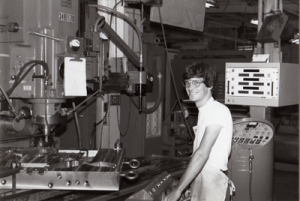
20 Years old, during my apprenticeship at Anson Tools & Gages.
How serious were they at Anson's? Well, for starters, I had to take an aptitude test to see if I even met their standards. Once I passed that, I was called in for my formal interview. And what an interview it was:
I remember it like it was yesterday: me - sweating profusely like I had some kind of disease - and six other people crammed into the owner's office. In fact, I can STILL remember who was there that day some 40 years ago:
- B. Anderson, President
- Joe Leto, Vice-President
- Bob Wesmiller, Co-Foreman
- Bob Shuster, Co-Foreman
- Harold Yannayon, Head Engineer
- John Matz, Apprentice Supervsior
- And very sweaty 19 year-old Phil Kerner
Wow. Can you even imagine that today? The top six people at any plant grilling a potential apprentice?
As the years went by, I would eventually start my own shop and trained my apprentices with the same love and care that I was shown by Mr. Anderson. To this day, I still get notes and letters from my former apprentices thanking me for doing my best for them. I always gave them a very long rope to hang themselves with, and most of them did a terrific job for me.
So, what happened to apprenticeships? Good question.
Houston, we have a problem.
We are now at the point where an entire generation is being raised with the idea that someone who "works with their hands" is either "stupid" or "uneducated."
I can assure you that here - at The Tool and Die Guy.com - that view is distained beyond belief and in fact really pisses us off. "Us" as in "me."
The problem - at least for me - looks to be twofold.
One: the work is SO hard to get. Companies still closing - still! - after seeing their customers go offshore. It's really tough to commit to a training program when you have no idea if you'll meet payroll next week.
The second problem is that companies are concerned about losing their trainees once their training has been completed. And it's fair to worry about that.
Once I completed my own apprenticeship, I sat down with the owner to see what my future looked like...and it wasn't pretty.
The same rigidity that had given me such a great apprenticeship was now being applied to my future: I was to send the next year on second shift. No raise. No talk about my future. Incredibly...I was just going to pretty much employee #102 for the rest of my life.
So...I left. Because of my training, I was immediately snapped up by another shop and was top-rate in just a few years. Anson's squeezed out top-rate after like 20 years.
They blew it. They had a kid who was hungry for more...and offered nothing. Their stance was rigid and they would rather lose me rather than challenge me with goals for my future.
Today, I hear that fear every time when I talk to shop owners and HR folks about training / apprenticeship programs: they don't want to train folks well only to see them leave for more money.
Here's how to fix it...at least most of it:
- Decide on a training program, and stick to it
- Decide if you want it to be your own or state-approved
- Decide on a two-year or four-year program
- Assign someone to be in charge of the trainees / apprentices
- Either program needs goals: guaranteed rate increases every six months based on trainee / apprentice meeting goals
- The person in charge of them needs to meet with them once a month to assess progress
- Suck it up and realize that some of them might leave after you train them so well
- Pick out your best graduates and give them a reason to stay / money / incentives
As a former shop owner, I can tell you a dirty little secret: don't ever forget that a good apprentice / trainee can really help with your direct labor rate. In many cases, a $10 / hr apprentice can be trained to do $40 / hr work if they are sharp kids. Don't ever forget that even if they leave you, if managed correctly they should turn a profit for you.
Personally...I always tried to hire "farm" boys. Kids that grow up in the country are just a little bit more mechanically inclined and are much better self-starters.
I'll end with this: I get it. It's painful to spend the time and money to train kids only to see them leave for 25 cents an hour. You've given them the training and confidence to be a much-needed commodity to those cheap shops that don't spend a nickel to train anyone.
I think that the balance here is to get these kids to buy-in and feel like they are part of something special instead of treating them like a nuisance. That part comes from mentoring in a purposeful way.
Several years ago, one of my sons signed to play football for Joe Paterno at Penn State. What Joe had created there was an atmosphere where they basically beat the living hell out of these kids but somehow they knew that they were part of something very special. Most of the guys who went through it hated Joe for four years and by the time they were thirty, it all made sense.
No doubt: setting up a training system is difficult. Start small. Set goals. Mentor them. Discipline them.
But figure out who the "keepers" are and you'll figure out how to keep them.
If you have any interest in contacting me regarding setting up your own customized training program for your business, please feel free to contact me via email for a consultation.




Phil- one way a company “Keeps” folks in my area is to offer a buy-IN and match program for company ownership- over a 4 year period a set amount is placed in company holdings FOR the apprentice… If they complete a 3 year contract to “pay off” the education. When you leave- if after the 3 year commitment- the money is the (now journeyman) employees… if before the 3 year mark- it belongs to the company offsetting the cost of the apprenticeship. Several of the folks who wanted to leave stayed because they see the cash they will loose as well as the incentive to stay and keep building that nest egg. By the way- at the 3 year post apprentice mark the $$$ gets rolled into a company 401K so it becomes the employees.
-Just a thought about how some handle it.
nice thoughts 🙂
Good advice on attracting and training employees through a well structured apprentice program. It is not always the money that will retain the top employees. A very good boss is usually ranked number one. Letting them know they are making a significant contribution to the success of the company and their expertise is needed are some of the other top motivators to retaining the very best employees. Ironically, salary is a short term motivator and typically lower on the list of what retains the best employees.
Regardless of politicians (psychopath “elites” running western world) and their sabotage (on economy, law, science, education, manufacturing), YOU (older, experienced guys) should teach younger ones anyway!
It’s your (unwritten) duty/obligation/must. Knowledge does not “belong” to you (you must pass it to the next guy). At least try (find one with patience, desire to learn, and to get his/her hands dirty).
If there’s no formal/official apprenticeship program in your work place, you should start traditional “master – student” relation with younger employee anyway. Don’t ask for “permission”. Just do it.
It is possible especially in “one-off” prototype/repair/maintenance shops (maybe not so much in mass production CNC environment).
I’m outside US. But, for example, we have here obligatory 1-3 (sometimes 6) months pseudo-apprenticeships for mechanical engineering students (during summer vacation time). Even with that amount of time you can teach some basics. Milling, lathe, welding, order of operations, work-holding, inspection, drawings and proper dimensions/tolerances. I ask them (as a homework) to design small and simple part…then we attempt to actually make it. Most will do the same mistakes (design flaws) of course. We discuss it and fix it. When it’s finished, they can keep it, take it home (show to family and friends “my first machined part”). You try to make them “feel it” – that this is cool to make things with your hands.
With no experience, one can participate (with some guidance) in most projects, do some non-critical operations (drill clearance hole, chamfer, de-burr). As someone above mentioned, young guy must feel, that he is a part of the team, he helped to make or fix something (and, at the end of the day, “non-critical” feature was important too).